An end-of-life admin app rebuilt with every business rule accounted for, in a four-day agent build
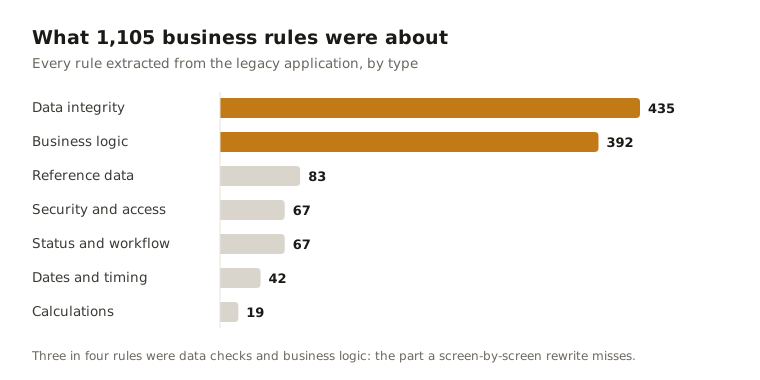
A large enterprise's internal administration app had no tests and an end-of-life front end. ARC found more than 1,100 business rules in it, agreed the target with the client's team, and delivered tested code after a four-day build.
- Customer
- Large enterprise, internal operations
- Legacy
- .NET and Angular web app over Oracle
- Target
- Current .NET and Angular, same database
- Engagement
- Discovery and Audit through code gen
 Challenge
An app nobody wanted to change
The app ran a core part of the operation, and its front-end framework had been out of support for years. There were no automated tests, much of the logic sat in a few very large classes, and ARC's audit found security issues serious enough to fix before anything else. The people who knew the rules were busy running the business.
SolutionRules first, then a plan, then the build
- Discovery and Audit.ARC read the code and the database and wrote down every business rule it enforced, each cited to its source.
- A target the client agreed.Keep the database as it is and keep the app's external behaviour, so nothing downstream breaks.
- A plan that owns every rule.Each rule was assigned to exactly one part of the plan, and the plan didn't pass review until none were left over.
- The build.AI agents built the plan piece by piece. Every piece was tested and reviewed before it counted.
Nothing was built until every rule had exactly one owner in the plan.Outcome
Tested from the inside and the outside
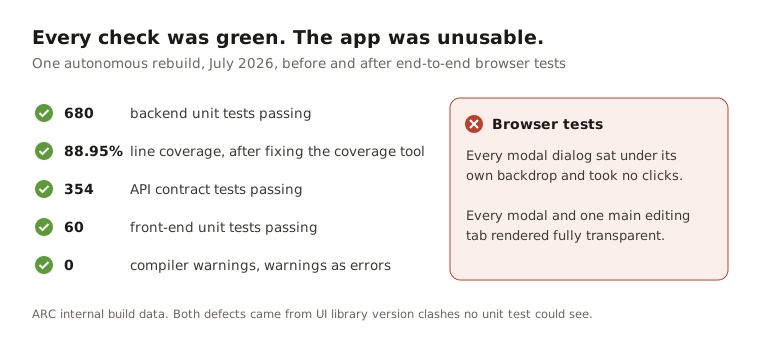
Every unit metric was green before the browser tests ran, and the browser tests still found two defects that made dialogs unusable. Both were fixed before handover. Checks that depend on specific production data are scheduled against the client's own environment.
What you get
What this means for you
If your application works but nobody dares change it, the risk isn't the rewrite. It's the rules nobody wrote down. Start by getting every rule out of the code with a citation, agree what the new system must keep, and only then let anything build.
Next step: a Discovery and Audit
Fixed scope and a fixed price set by the size of your code, from $1,000. You get the business-rule inventory, a security and risk map, a duplication and maintainability report, and a modernization plan with a cost estimate. You decide on the rest once you've seen it.
Read more
Timelines depend on access to code and people; we confirm them on the scoping call.